

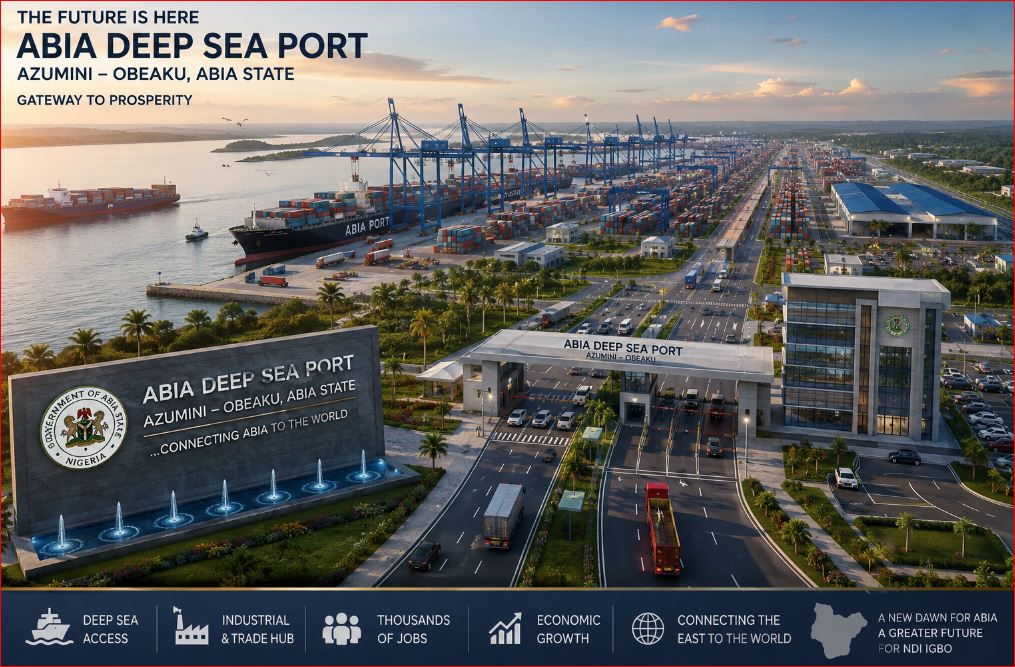
Governor Alex Otti and the Abia Seaport Vision: A New Economic Dream for Ndi Igbo
In recent years, the administration of Alex Otti has increasingly become one of the most discussed political transformations in southeastern Nigeria. Since assuming office as Governor of Abia State in 2023, Otti has projected himself as a leader focused on infrastructure renewal, economic revival, transparency, and practical governance.
Across cities such as Aba and Umuahia, many residents have witnessed major road rehabilitation projects, sanitation improvements, educational reforms, digital governance initiatives, and renewed investor confidence. Aba, long known as the commercial heartbeat of the southeast, has particularly experienced visible reconstruction of roads and commercial infrastructure, restoring confidence among traders, manufacturers, and entrepreneurs.
For many Abians and Ndi Igbo generally, Governor Otti represents a new generation of leadership that emphasizes competence over politics. Among supporters, he is often viewed as a symbol of disciplined economic thinking, shaped partly by his background as a banker and economist before entering politics.
Today, one of the boldest conversations surrounding his administration is the proposed development of a deep seaport and inland waterways corridor in Abia State, particularly around the Azumini–Obeaku axis.
The Seaport Initiative: A Strategic Economic Vision
Recently, Governor Otti approved the commencement of a feasibility study for the proposed Azumini–Obeaku seaport and inland waterways corridor project after discussions with the China Harbour Engineering Company Limited, a company associated with major infrastructure projects including the Lekki Deep Sea Port.
According to reports, the governor emphasized the need to fast-track the study while also beginning regulatory engagements with the Nigerian Ports Authority, the Federal Ministry of Marine and Blue Economy, and the Presidency.
The proposal is ambitious.
For decades, southeastern Nigeria has remained heavily dependent on ports located outside the region, especially Lagos and Port Harcourt, for import and export activities. This has increased logistics costs, delayed transportation of goods, and reduced the industrial competitiveness of southeastern manufacturers.
A functioning deep seaport in Abia could dramatically alter that reality.
What Would the Southeast Benefit?
The possible benefits of a successful Abia seaport project are enormous.
1. Industrial Growth in Aba
Aba is already one of West Africa’s most active indigenous manufacturing hubs, known for leather works, garments, footwear, machinery fabrication, and commerce.
A nearby seaport would reduce transportation costs for importers of raw materials and exporters of finished products. Manufacturers would gain faster access to international markets, while investors could view Aba as a stronger industrial destination.
2. Employment and Youth Opportunities
Construction of a modern seaport ecosystem would generate thousands of jobs directly and indirectly:
- Maritime operations
- Logistics and transportation
- Warehousing
- Ship services
- Customs and clearing operations
- Manufacturing expansion
- Hospitality and tourism
This could significantly reduce unemployment in the southeast.
3. Economic Decentralization in Nigeria
For many years, Nigeria’s maritime economy has remained concentrated around Lagos. An eastern seaport could contribute to balancing economic activity across regions and reduce pressure on already congested western ports.
4. Regional Integration for Ndi Igbo
Many Igbos across Nigeria and the diaspora see economic infrastructure as central to rebuilding southeastern competitiveness after decades of perceived neglect in federal infrastructure investments.
A successful Abia seaport could therefore become more than a transport facility; it could symbolize economic rebirth, regional confidence, and strategic self-development for Ndi Igbo.
But How Possible Is This Dream?
Despite the excitement, Governor Otti himself has acknowledged the challenges involved.
Reports indicate that the proposed location may require dredging of nearly 19 nautical miles to connect properly with the high sea, a process that would significantly increase costs.
Large-scale seaport development requires:
- Massive financial investment
- Federal approvals
- Environmental assessments
- Technical feasibility
- International partnerships
- Security guarantees
- Long-term political consistency
Governor Otti has publicly stated that the project would only proceed when viability and funding are properly secured, emphasizing that he does not want an abandoned mega-project.
That cautious approach has actually strengthened confidence among some observers, who believe that realistic planning is better than political promises without execution.
What Could Alex Otti Represent for Ndi Igbo?
If this project eventually succeeds, many believe Alex Otti could be remembered as one of the major economic reformers in southeastern Nigeria’s modern history.
For many Ndi Igbo, leadership is increasingly being judged not merely by speeches, but by measurable economic transformation.
A successful seaport initiative would represent:
- Strategic thinking
- Economic modernization
- Regional competitiveness
- Diaspora investment attraction
- Long-term infrastructure vision
It could also inspire broader southeastern collaboration among states on transportation, manufacturing, exports, and regional trade integration.
Where Does Brazil Enter the Picture?
The relationship between Brazil and southeastern Nigeria, especially among Igbo communities, is deeper than many realize.
Brazil is one of the world’s major maritime economies, with strong experience in port operations, agribusiness exports, logistics, ship management, and industrial trade corridors. Cities such as Santos host some of Latin America’s busiest port systems.
For Ndi Igbo in Brazil and the wider diaspora, an Abia seaport could open future opportunities in:
- Brazil–Nigeria trade partnerships
- Export of agricultural products
- Machinery importation
- Maritime training cooperation
- Manufacturing partnerships
- Diaspora investment channels
- Cultural and commercial exchange
Many Nigerian entrepreneurs living in Brazil already engage in trade involving food products, machinery, fashion, and industrial materials. Improved maritime infrastructure in the southeast could strengthen direct commercial links between southeastern Nigeria and South America.
In another dimension, Brazil itself represents an example of how port cities can transform regional economies through logistics, manufacturing, and export systems. This is part of why many African business observers increasingly look toward Brazil not only culturally, but also economically.
A Vision Beyond Politics
Ultimately, the Abia seaport conversation is bigger than politics.
It is about whether southeastern Nigeria can reposition itself economically in a rapidly changing global economy.
It is about infrastructure, industrialization, trade, and opportunity.
And perhaps most importantly, it is about vision — the courage to imagine the southeast not only as a commercial people, but as owners of globally connected economic systems.
Whether the project fully materializes or not, Governor Alex Otti’s willingness to initiate the conversation has already sparked renewed imagination among many Abians and Ndi Igbo across the world.
Oi, isto é um comentário.
Para iniciar a moderar, editar e excluir comentários, visite a tela Comentários no painel.
Os avatares dos comentaristas vêm do Gravatar.